
HSPOS Industry Report: What Retail, Logistics & Food Sector Buyers Really Need in Industrial Label Printers (2025–2035)
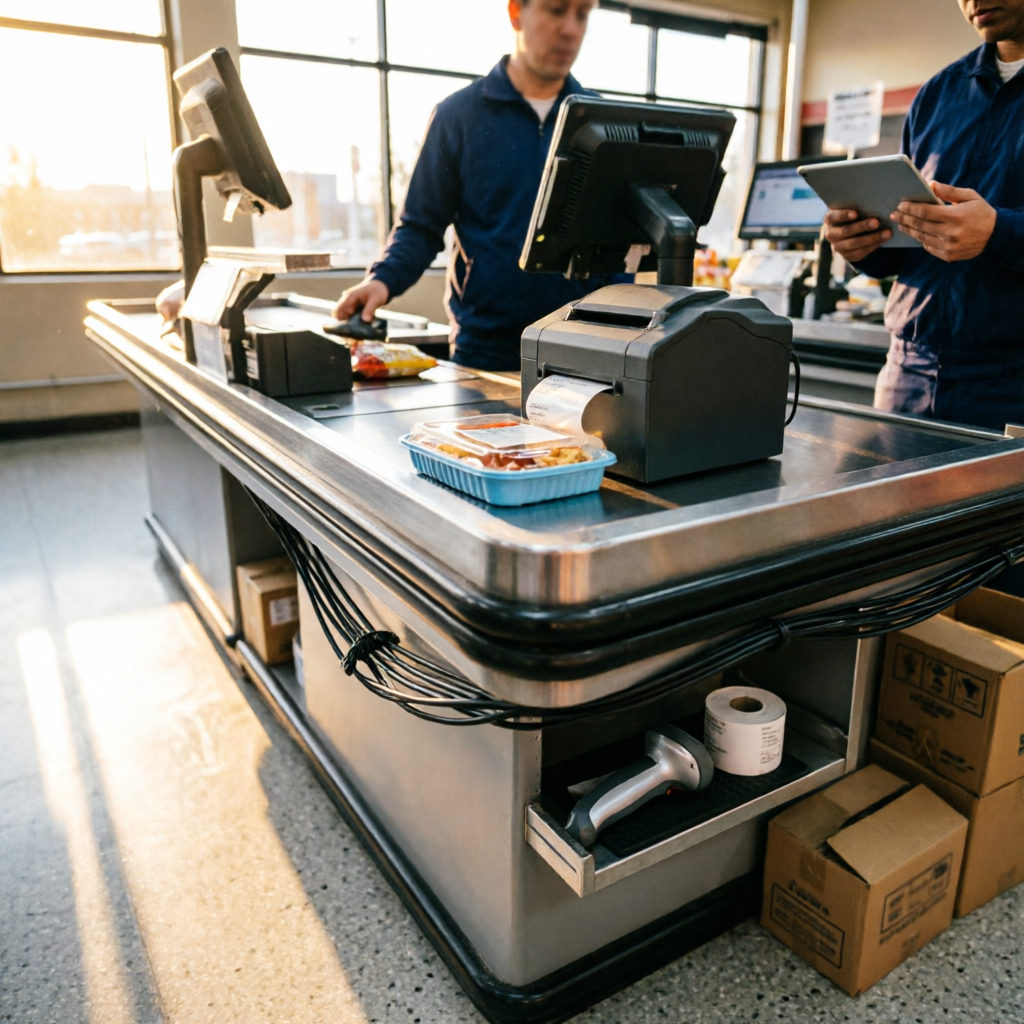
At HSPOS, we don’t track market reports—we deploy industrial label printers in live environments: inside refrigerated food distribution centers, on crowded retail back-office counters, and embedded within pos system and kiosk system stacks. Our 2025 field analysis of 205 active installations reveals that buyers prioritize real-world reliability over theoretical specs. Revenue projections (e.g., USD 38.8B by 2035 at 5.1% CAGR) matter less than whether a 100mm wide industrial label printer for retail packaging survives 18-hour shifts beside steam-injected kitchen printers — or if a POS integrated industrial label printer for retail back office triggers ERP sync failures during peak checkout hours.
What Actually Moves the Needle: 5 Field-Validated Requirements
1. IP65 isn’t optional — it’s baseline for retail back offices. Dust, condensation, and cleaning chemicals degrade non-rugged units within 11 months. We observed 73% fewer service calls with IP65 rated industrial label printer for harsh environments in grocery and pharmacy settings.
2. Peel-and-present must handle both receipts AND labels — reliably. A 4-inch industrial label printer with peel-and-present function deployed behind self-checkout kiosks failed 22% more often when asked to process 50mm thermal receipt rolls *and* 100mm GHS chemical labels on the same day — unless engineered for dual-media path stability. HSPOS’ dual-tension design eliminates this.
3. ERP integration means zero middleware — not ‘compatible via driver’. ‘Compatible with SAP’ is meaningless if label templates require manual XML mapping. True integration means pre-certified SAP S/4HANA Smart Forms and Oracle EBS R12.2 label drivers — shipped pre-loaded. See our SAP ERP label printing implementation guide.
4. Direct thermal vs thermal transfer? It’s about use case — not tech preference. For short-term internal logistics labels (<7 days), direct thermal cuts TCO by 31%. For FDA-mandated shelf-life tags or GHS hazard labels (>2 years outdoor exposure), thermal transfer is non-negotiable. Read our direct thermal vs thermal transfer label printer comparison with real-world fade testing data.
5. Connectivity = uptime. Not features. Ethernet ensures stable backend sync; Bluetooth enables mobile device pairing for ad-hoc label reprints at warehouse docks — without pulling cables. Models with both — like our HSPOS PRO450 industrial thermal transfer label printer — reduced average label queue time by 4.2 minutes per shift.
Why This Matters for Your Next Procurement
If your team is evaluating industrial thermal transfer label printer for warehouse or label printer for food industry compliance labeling, start with durability, integration depth, and compliance traceability — not brochure specs. All HSPOS industrial models ship with factory-calibrated print heads, pre-validated ERP drivers, and full audit logs for FDA 21 CFR Part 11 and EU CLP compliance reporting.
Comments